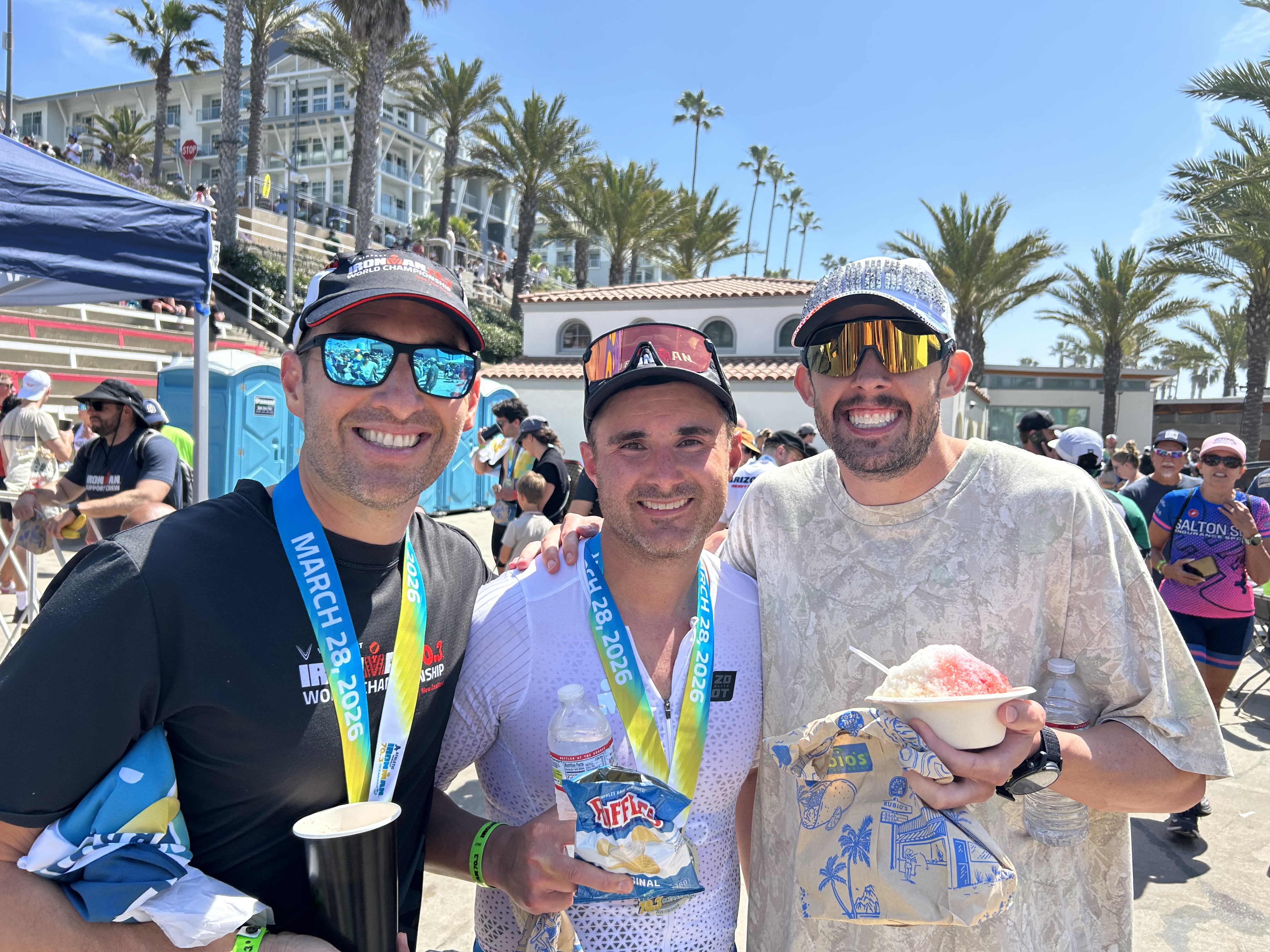
This was my third time racing the Oceanside Ironman 70.3. I love this race. The ocean swim. The ride through a military base. The run by the beach. It all makes for a beautiful weekend.
Five months ago, I set the ambitious goal of finishing sub-five hours with a swim under 30 minutes and a run faster than 8:00 pace per mile. I called it the 30-8-5 Club and made that the name of my AirPods.

For context, I did 5:55 in 2022 and 5:34 in 2024.
My training was mostly steady with one major setback. I got sick in late December for 10 days. I showed up on race day healthy and optimistic. But races don’t happen on paper.
The Swim
Both the air and water temperatures were much warmer than in 2024, when my toes were numb until 30 minutes into the bike.
The gun went off, and I went full send on the swim. I was set on finishing under 30 minutes, something I’d never done before. I struggled to catch my breath for the first 300 meters before settling into a rhythm. I kept reminding myself not to worry about the bike and the run. Even if I burned a match on the swim, I’d be okay.
On most triathlon swims, I’m able to find feet and draft off others, but this time I couldn’t. I’d draft for a few seconds, realize I was going slower than I wanted, then pass them, continually looking for the next set of feet.
Coming out of the water, I saw my time was about 29:25, which I was really happy with.
The Bike
Oceanside has a very long transition area. I hustled through, grabbed my bike, and was off. I planned to go hard on the bike, averaging 230 watts for as long as possible. This would be more challenging than my swim and run goals.

Mentally, I broke the bike into three segments:
- Segment 1: The first ~25 miles are mostly flat with lots of turns. I held 230 watts for the first 15 miles, then backed off slightly as I could feel my legs getting tired, and we hadn’t hit the climbs yet.
- Segment 2: The next 20ish miles are the hardest as there are several large climbs during this segment. I pushed steady watts up the hills, but backed off on the downhill as I still don’t feel very comfortable with fast descents.
- Segment 3: The last 10 miles are mostly flat heading back into town. I dropped a water bottle at one aid station. At another, I tried to refill my bottle but didn’t realize the cap was closed. just as I was tossing it to the road. I had no water for the last 10 miles and was thirsty. There’s often a breeze pushing against you during this segment, but I didn’t feel it at all. Those final 10 miles were fast.
The Run
Still, I came into T2 slightly slower on the bike than I had hoped. If I wanted to finish in under five hours, my run needed to be faster. My goal was to run 8-minute miles, but I’d have to run closer to a 7:45 pace to have a chance.

I went out at that pace, and it felt better than expected. I drank a bunch of water at the start, so dehydration became a non-factor. The first turnaround was three miles in. I immediately felt the ocean breeze, which felt great but slowed my pace slightly. By mile seven, my quads were really in real pain.
I thought back to the St. George Marathon in October. 16 miles in, my quads were screaming. I still had 10 miles left and the downhill sections were taking a toll. Despite the pain, they didn’t give out and I finished strong. That experience gave me confidence that I’d be able to push through the pain.
I hit the final turnaround and had three miles left to go. I was still holding a 7:45 pace, and my body was begging me to slow down. I knew I’d be close to the five-hour mark and didn’t want to cross the finish line 20-30 seconds slower, feeling like I could have gone harder. If I finished 5:00:30, I wanted confidence that I gave it my all.
The last mile was particularly painful. I felt like I was pushing twice as hard as I was at the beginning of the race, but running the same pace.
The Finish
One final push. I crossed the finish line, turned around, and looked at the clock. It flashed my name and said 4:58:48. I screamed in celebration. A flood of emotions poured over me. Then the exhaustion hit. I put my hands on my knees for a split second and then collapsed to the ground.
A volunteer quickly helped me up and told me we had to keep moving. She handed me water. I was fighting back tears. My friend Tyler, who finished well ahead of me, was at the finish line and recorded it. It was a special moment.
Takeaways
My main takeaway from the Oceanside Ironman 70.3 is that clear goals always beat vague desires. My 30-8-5 plan drove my training leading up to the race and my mindset during it.
If your priorities aren’t visible, they don’t exist. This is why I encourage clients to write down their goals every day. It keeps the main thing the main thing.
There’s no better feeling than working hard and accomplishing something your former self thought was impossible. Four years ago, at age 38, I did a 5:55 in Oceanside. I was ecstatic. I wouldn’t have believed sub 5 was possible, especially as I got older.
My next big race is the Boise 70.3 in July. I know what’s needed to improve. I’m confident there’s more potential to unlock. Back to work.